





From Starter SMT Line to High-Speed Production: A Practical Path for Scaling Electronics Assembly
Table of Contents
Key takeaway:
The most effective SMT lines are not defined by maximum speed, but by how consistently and efficiently they run as your production scales.
1. Introduction: Scaling SMT Is About Fit, Not Just Speed

When OEM Macurco needed to scale up, they easily added a second MC889 pick and place machine to their Manncorp SMT line, doubling their placement capacity and boosting their throughput capability to 500 circuit boards per day. (Read more)
Scaling an SMT operation isn’t about buying the biggest or fastest equipment available. It’s about building a line that fits how your production actually runs today—and how it will evolve tomorrow.
Manufacturers at different stages face different constraints:
- Beginners need reliability, flexibility, and fast learning curves
- Growing manufacturers need higher throughput without losing control
- Mature operations need sustained output and predictable performance
Manncorp’s approach is to align equipment capability with real production demand, so manufacturers can scale confidently without unnecessary complexity or premature investment.
This is why Manncorp works equally well for companies building their first boards as it does for those expanding into higher-speed production.
Right-sizing SMT equipment maximizes usable throughput, flexibility, and return on investment, rather than paying for theoretical performance that goes unused.
2. Understanding SMT Line Maturity Levels
SMT production doesn’t jump from “entry-level” to “fully optimized” overnight. Most successful manufacturers progress through clear stages as volumes, mix, and operational discipline increase.
Typical SMT Line Stages
|
Stage |
Primary Focus |
Typical Volume |
Line Characteristics |
|---|---|---|---|
|
Starter SMT Line |
Getting boards built reliably |
Prototypes to 1k boards / month |
Manual or semi-automatic |
|
Growing Production |
Removing bottlenecks |
1k to 10k boards / month |
Entry-level automation |
|
Mid-Speed SMT Line |
Balancing throughput and flexibility |
10k-50k boards / month |
Balanced throughput |
|
High-Speed SMT Line |
Sustained, predictable output |
50k+ boards / month |
Optimized, multi-lane, data-driven |
Each stage benefits from different equipment priorities. Choosing equipment that fits your current stage—while allowing for growth—keeps utilization high and scaling manageable.
Understanding where you are—and where you’re going—can save you a lot of headaches and unnecessary expense.
Scaling Decisions Manufacturers Commonly Face
3. Starter SMT Lines: Building Confidence and Capability
A starter SMT line is designed to help manufacturers begin in-house assembly with reliable, repeatable production while building operator experience and process confidence.
Rather than maximizing speed, this stage prioritizes usability, stability, and learning.
Starter SMT lines exist to answer one question: “Can we build our own boards reliably and repeatably?”
A starter SMT line is about more than placing components. It’s about establishing a stable, repeatable process.
At this stage:
- Volumes are inconsistent
- Product mix is high
- Engineering changes are frequent
- Operators are still gaining confidence
Deploying equipment designed for high-speed, high-stability environments often introduces higher training requirements, longer setup and programming times, lower effective utilization, and slower iteration cycles.
It also requires significantly more floor space than a right-sized starter line.
Common Starter-Line Needs
- Moderate volumes with frequent design changes
- Simple workflows operators can master quickly
- Equipment that is forgiving and easy to adjust
- Capital efficiency
Typical Starter Equipment

Entry-Level Pick and Place Machines

Manual or Semi-Automatic Stencil Printing
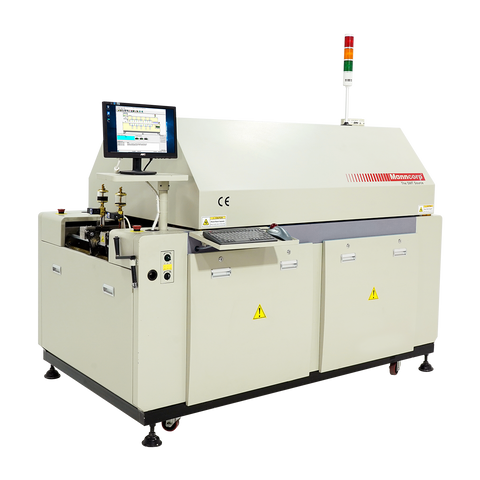
Batch or Compact Inline Reflow Ovens
At this stage, the goal is flow and consistency, not peak throughput. Equipment that is easy to program, use, and maintain often produces more usable output than more complex alternatives.
Early-stage SMT success comes from flow and repeatability—not raw speed.
Key Indicators That a Starter Line Is Succeeding
- Consistent first-pass yields, showing stable printing, placement, and reflow processes.
- Predictable daily output, even if volumes are modest.
- Operators able to run the line independently, without constant engineering intervention.
- Changeovers completed without disrupting schedules, supporting mixed production.
When these indicators are present, the line is providing a solid foundation for future scaling.
4. How Do I Know It’s Time to Scale My SMT Line?
Scaling becomes necessary when production bottlenecks are consistent, such as pick & place utilization regularly over 80%, reflow limiting throughput, or changeovers consuming too much production time.
Most manufacturers don’t replace starter lines because they “want faster equipment.” They upgrade because bottlenecks appear.
Common Growth Signals That Indicate It's Time to Scale
Manufacturers often recognize the need to scale their SMT line through a set of repeatable operational signals. These indicators show up on the production floor before throughput targets are formally missed.
-
Pick and place utilization consistently above 75–80%
When placement machines operate near capacity for extended periods, even small disruptions—changeovers, feeder issues, or operator delays—can immediately limit output and create scheduling pressure. -
Changeovers consuming a growing share of available production time
As product mix increases, frequent changeovers can reduce usable runtime more than placement speed limits, making parallel capacity or dedicated machines more effective than faster platforms. -
Reflow oven throughput matching or exceeding upstream placement
When boards queue before reflow or profiles must be rushed to keep up, it often signals that line balance—not individual machine speed—is becoming a constraint. -
Engineering or prototype work disrupting production schedules
Using the same pick and place machine for both NPI and production frequently leads to downtime, priority conflicts, and delayed shipments as volumes grow. -
Rising rework or inspection backlog
As output increases, manual inspection or limited inspection capacity can become a hidden bottleneck, slowing shipments even when placement and reflow are not constrained. -
Operators spending more time managing flow than running machines
When skilled operators are primarily moving boards, staging material, or resolving handoffs between processes, automation or additional capacity may deliver more benefit than higher placement speed.
At this point, the constraint is no longer basic capability—it’s line balance and sustained throughput.
Scaling successfully often means addressing these constraints at the line level, not just upgrading individual machines.
Line-level scaling typically includes:
- Matching placement speed to printing and reflow capacity
- Reducing changeover time across the entire line, not one machine
- Ensuring conveyors and buffering support steady throughput
- Aligning equipment complexity with operator skill and staffing levels
By addressing constraints collectively, manufacturers can increase output without overbuilding any single part of the line.
In most SMT environments, sustainable throughput comes from line balance—not from the fastest machine on the floor.
This system-level approach allows manufacturers to scale in a controlled, predictable way, preserving flexibility while steadily increasing usable output. Manufacturers who scale at the line level tend to see higher utilization, faster ROI, and fewer disruptive upgrades.
5. Mid-Speed SMT Lines: The Balance Point
For many OEMs and CEMs, mid-speed SMT lines deliver the best combination of throughput, flexibility, and return on investment. Mid-speed SMT lines are often overlooked because they don’t dominate spec sheets. In practice, they dominate usable throughput per dollar.
What Defines a Mid-Speed Line
- Faster placement with realistic utilization
- Increased feeder capacity for mixed production
- Inline reflow sized to support placement speed
- Conveyors and buffering to stabilize flow
Typical Mid-Speed Equipment
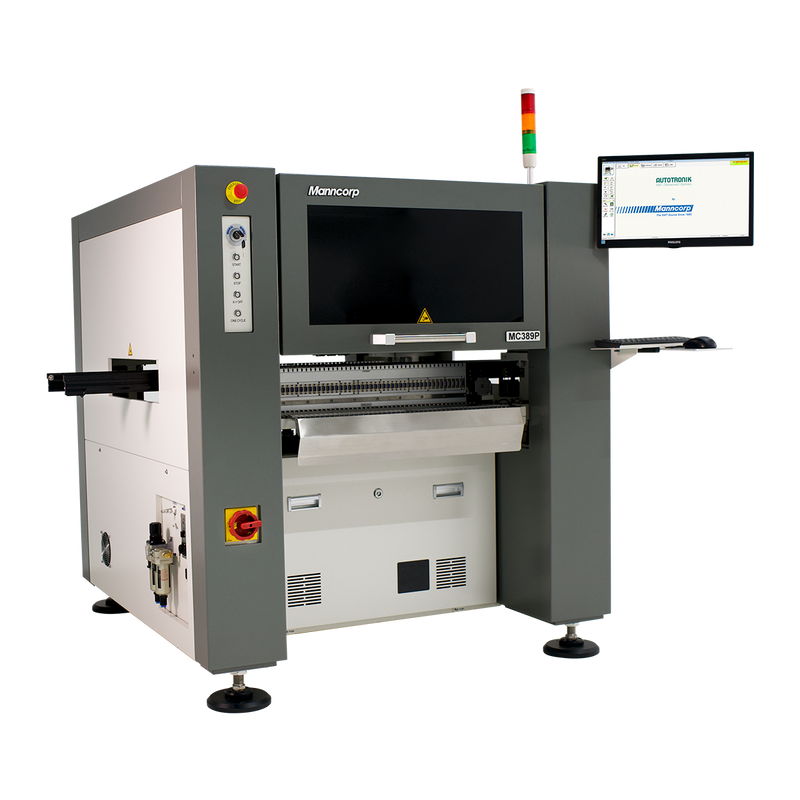
Mid-Speed Pick and Place Machines

Automatic Batch Stencil Printing

Compact Inline Reflow ovens

Conveyors & PCB Handling
Mid-speed lines are designed to:
- Handle growth without becoming rigid
- Maintain manageable changeover times
- Run closer to rated capacity in real production
This makes them especially effective for North American manufacturers balancing volume with product variation.
Why Mid-Speed Lines Win in North America
- High utilization across mixed production
- Faster changeovers than ultra-high-speed systems
- Lower staffing and maintenance overhead
- Easier cross-training
- More forgiving during schedule volatility
For many OEMs and CEMs, mid-speed lines:
- Run closer to their rated capacity
- Produce more boards per shift
- Pay for themselves faster
Peak CPH matters less than how often—and how easily—you can run the line at speed.
6. High-Speed SMT Lines: Scaling with Stability
High-speed SMT lines are designed for sustained output, not experimentation. When production becomes predictable and disciplined, higher-speed architectures deliver strong results.
When High-Speed Makes Sense
- Volumes are stable and repeatable
- Product designs are mature
- Changeovers are planned and controlled
- Staffing and maintenance resources are established
In these environments, high-speed lines provide consistent throughput and long-term efficiency. Manncorp supports these builds by designing systems that integrate smoothly with upstream and downstream processes.
Typical High-Speed Equipment

High-Speed Pick and Place Machines

Automatic Inline Stencil Printing

Inline Reflow Ovens

Conveyors & PCB Handling

Inspection Equipment
7. When Scaling Means Adding Flexibility, Not Speed
When Should I Add Flexible, Lower-Speed SMT Capacity?
Manufacturers should add flexible, lower-speed SMT capacity when changeovers, product mix, or scheduling conflicts limit usable production time more than placement speed does.
In high-mix or evolving environments, adding parallel capacity often increases output more effectively than replacing a machine with a higher-speed platform. Faster machines deliver value when product mixes are stable, but flexibility becomes the limiting factor long before peak CPH is reached.
Scaling SMT production doesn’t always mean pushing more volume through the same line. Many manufacturers choose to add smaller or dedicated SMT capacity to support:
- Prototyping and new product introduction (NPI)
- High-mix, low-volume builds
- Engineering changes that would disrupt a high-volume line
- Short-run or specialty assemblies
In these cases, a compact or entry-level SMT line allows teams to:
- Protect high-volume production uptime
- Move faster on development and validation
- Avoid frequent changeovers on primary lines
Rather than replacing existing equipment, these systems extend production capability by handling work that doesn’t fit a high-speed environment.
Manncorp frequently designs SMT layouts that combine high-throughput production lines with flexible, lower-volume lines, giving manufacturers the best of both worlds.
8. Pick and Place Machines: Choosing the Right Performance Level

Microsystems World CNC used Manncorp's Trade In, Trade Up program to upgrade their line to a MC389 pick & place machine (shown right) when they needed to scale up production. (Read more)
Pick and place decisions often focus on speed, but productive speed depends on more than CPH. In real production, usable speed is shaped by how quickly programs can be created and adjusted, how efficiently feeders are set up, and how often changeovers occur.
Key Considerations
- Feeder capacity vs product mix
- Programming and setup time
- Changeover repeatability
- Operator learning curve
A pick and place machine that is slightly slower on paper—but easier to program, change over, and staff—often produces more boards per shift than a faster system that spends more time idle or underutilized.
In high-mix environments, a machine that completes five fast changeovers in a shift will often outproduce a faster system that requires long setup times between jobs.
As volumes grow, many manufacturers try to use a single pick and place machine for both prototyping and production. In practice, this can introduce scheduling conflicts and inefficiencies, which is explored in Can One Pick and Place Machine Handle Prototypes and Production?
In practice, productive speed is the speed you can sustain across real shifts, not the speed listed on a specification sheet.
9. Reflow Ovens: Supporting the Line, Not Outrunning It

Campbell Company is running all but one of their pedestrian safety products on an SMT line with a 5-zone CR500 reflow oven. (Read more)
Reflow ovens should be selected to match line throughput, not exceed it unnecessarily. What matters most is that reflow capacity supports steady flow from printing through placement, with conveyor speed and thermal performance aligned to real production rates.
In practice, effective reflow selection focuses on:
- Thermal stability and profile repeatability across products
- Conveyor speed matched to placement throughput
- Zone configuration that supports required soak and peak times
- The ability to handle product variation without constant re-profiling
When reflow capacity is well-matched to the line, manufacturers achieve smoother flow, more predictable output, and fewer downstream disruptions—without paying for capacity that goes unused.
The goal of reflow is not to run faster than the line, but to keep the line running consistently.
As production scales, reflow capacity should grow alongside placement to maintain balanced flow.
10. Why Doesn’t Adding a Faster Machine Always Increase Throughput?
A faster SMT machine does not automatically increase throughput if changeovers, inspection, reflow, or material handling remain the true bottlenecks.
When increasing throughput, manufacturers often face a strategic choice between investing in a single higher-speed platform or adding parallel capacity. The tradeoffs between these approaches are examined in One Fast Machine vs Two Flexible Machines: Which Scales Better?
In many production environments, increasing placement speed simply moves congestion downstream or increases idle time elsewhere in the line. Sustainable throughput gains come from balancing the entire line and removing constraints in the correct order.
One of the most common scaling mistakes is upgrading a single machine class—usually pick and place—without addressing the rest of the line.
Real-World Throughput Is Constrained By:
- Printing and reflow capacity
- Changeover frequency
- Feeder setup time
- Operator availability
- Upstream/downstream imbalance
Adding a faster placer to an unbalanced line rarely increases output. It simply moves the bottleneck elsewhere.
This is where many manufacturers discover that:
- Their utilization drops
- Their ROI stretches
- Their operational complexity spikes
Once manufacturers decide to add capacity, the challenge becomes expanding without interrupting existing production. Practical approaches to doing this are covered in Adding a Second Pick and Place Machine Without Disrupting Production.
11. Turnkey SMT Lines: Designed as Systems
Turnkey SMT lines work best when designed as integrated systems, not collections of machines.
A well-designed turnkey line considers:
- Line balance from printing through reflow
- Upgrade paths for placement and handling
- Floor space and power requirements
- Training and support at each growth stage
Manncorp’s turnkey approach is built around how manufacturers grow in practice, allowing lines to evolve without disruptive redesigns.

12. Why Manncorp Works for Beginners and Growing Manufacturers
Manncorp specializes in building SMT lines for companies that:
- Don’t have in-house SMT architects
- Need equipment matched to real production goals
- Want guidance before and after installation
By focusing on fit, balance, and scalability, Manncorp helps manufacturers:
- Get productive faster
- Maintain high utilization
- Scale with confidence
13. Next Steps: Choosing the Right Path Forward
Starting or scaling SMT production isn’t about choosing a machine—it’s about choosing the right path forward.
Before adding equipment, most manufacturers benefit from stepping back to evaluate:
- Their real-world production needs
- How their line runs today
- What’s limiting output now versus later
- Which upgrades will have the biggest impact
Manncorp helps manufacturers at every stage—from first-time SMT buyers to growing production teams—by designing lines around real production needs and practical growth.
Whether you’re launching your first SMT line or expanding an existing operation, Manncorp designs systems that grow with your products, volumes, and mix.
The best next step is a short, production-focused conversation to determine what makes sense now and what can wait.
Send us a BOM for a Free Analysis and get a customized SMT equipment quote in hours—not weeks—based on your actual boards, volumes, and production goals.
Or reach out to start a conversation about your production:


