




 Back
Back


Full-Scale Performance in a Compact Design
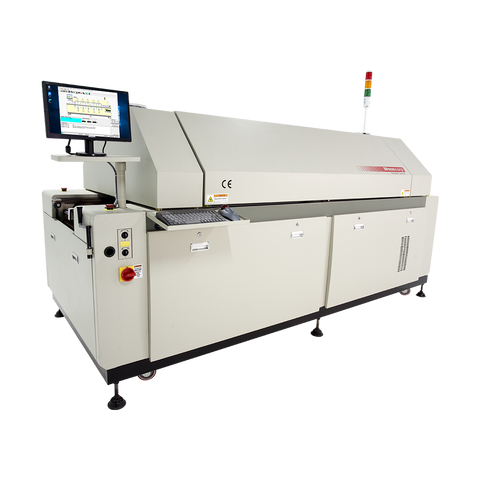
The CR4000C delivers full-scale reflow performance in a compact footprint using true forced hot air convection for consistent thermal results.
- Forced hot air convection: more consistent than infrared heating
- ±2°C temperature uniformity: ensures repeatable results across assemblies
- Compact footprint: reduces floor space and energy usage
- Production-level performance: comparable to larger reflow systems
This forced convection design provides stable, edge-to-edge temperature control, ensuring consistent and reliable reflow across every board.

Flexible, Precision Conveyor System
The CR4000C features a combination edge/pin conveyor with stainless steel mesh, supporting assemblies up to 16" (400 mm) wide.
- Edge/pin conveyor system: supports stable board transport
- Up to 16" (400 mm) width: handles a wide range of PCB sizes
- Mesh support: improves handling for different board types
- Double-sided processing: supports flexible SMT workflows
This versatile conveyor design allows reliable handling of both standard and double-sided PCBs with consistent transport accuracy.

Smart Automation for Ease and Reliability
The CR4000C includes built-in automation features designed to simplify operation and maintain consistent performance over time.
- Automatic pin-chain lubrication: ensures consistent preventative maintenance
- Motorized width adjustment: fast, pushbutton setup changes
- Motorized hood opening: improves accessibility and serviceability
- Reduced operator effort: minimizes downtime and manual intervention
These automation features help maintain consistent operation, reduce maintenance effort, and improve long-term system reliability.

Energy-Efficient, Precise Thermal Control
The CR4000C delivers precise thermal control with low energy consumption, using 5–8 kW of power while supporting temperatures up to 300°C for demanding reflow processes.
- 5–8 kW power consumption: energy-efficient operation
- Up to 300°C: supports high-temperature reflow processes
- 4 top + 2 bottom convection zones: consistent heating across assemblies
- 52" (1320 mm) heating length: ensures stable thermal profiles
- 3 thermocouple inputs: accurate temperature monitoring and control
Timed startup and shutdown functions help coordinate production schedules while reducing energy usage.
| CR4000C Specifications | |
|---|---|
| # of Zones | 4 Upper, 2 Lower (Controlled by Upper) |
| Heating Mode | Hot Air Forced Convection |
| Heated Tunnel Length | 52" (1320 mm) |
| Temp Control | PID (Proportional-Integral-Differential) & SSR |
| Temperature Range | Ambient - 280°C |
| Precision of Temp Control | ±1° C |
| Delta T | ±2° C |
| Cooling Zones | 1 |
| Cooling Method | Air |
| On-Board Profiling with 3 Thermocouple Inputs | Yes |
| Ramp Up Time | ~35 min |
| Flux Management System | No |
| Mesh Belt Width | 19.7" (500 mm) |
| Pin Conveyor Width | 1.97"-15.75" (50-400 mm) |
| Max Component Height Upper | 30 mm (Above Pins) |
| Max Component Height Lower | 25 mm |
| Conveyor Speed | 0.2-0.9M/min (7.8-35") |
| Conveyor Direction | Left-Right |
| Conveyor Height | 900 mm ±20 mm |
| Operating System | Windows 10 |
| Automatic Chain Lubrication | Yes |
| Power Requirement | 220 V 3-Phase, 62A, 60Hz |
| Power Consumption | 4-4.5 Kw |
| Total Power | 19 Kw |
| Compressed Air Supply | 80 psi |
| # of Exhaust Ports | 2 |
| Exhaust Opening Size | 6" |
| Total Exhaust Venting | 800CFM (400CFM Per Port) |
| Hood Opening Mechanism | Electric Raise and Lower |
| Net Weight | 1870 lbs (850 kg) |
| Machine Dimension | 79" L x 47.2" W x 57" H (2000 x 1200 x 1450 mm) |
| UPS for Conveyor and PC | Yes |
| Shipping Dimension | 89.4" L x 59" W x 73" H (2270 x 1470 x 1850 mm) |
| Shipping Weight | 2090 lbs (950 kg) |
| CE Compliance | Yes |
| Options | |
| Nitrogen Atmosphere Compatible | No |
| Infra-red (IR) | No |
| Central Support | No |
| SMEMA Compatible | Yes |
| Wider Pin and Mesh Conveyor | 15.7" (400 mm) |
| Internal Chilled Water Cooling | No |
| Exterior Chiller | No |
How 'Auto Focus Power' Profile Prediction Works:

1. Select Your Solder Paste Formula and Process Window
The KIC Auto-Focus Power software includes a database of over 1000 different solder paste formulas from dozens of different solder paste manufacturers. Each database entry includes the manufacturer's recommended solder profile for that specific solder paste formula and identifies critical specifications (i.e. maximum ramp rate, maximum cooling rate, temperatures for preheat, soak, reflow, and peak, allowable times above those temperatures, etc., with upper and lower limits for each) that define the process window. After selecting the solder paste, users can either use the profile as is or can modify the specifications to create a process window that meets their own unique criteria.

2. Link Your Product to the Process Window
Once the Process Window is selected (defined), the next step in using Auto-Focus is selecting the product to be soldered (or assigning a name if the product has not yet been defined). This step, in effect, links the product to the selected process window. It also links the process window and the product to the CR Series Oven data in the database. The oven data has been produced by KIC's characterization of the unique thermal properties of specific CR Series oven models as they relate to varying product sizes and processes.

3. Define the Product's Physical Characteristics
The user now enters the average length, average width, and total weight of the product.

4. Obtain and Confirm the Oven Settings
Auto-Focus now scans the built-in database for zone temperature/belt speed settings that produce a thermal profile that best fits within the process window when soldering a similarly sized product. By comparing that profile to the desired process window, Auto-Focus is able to estimate the PWI™ (Process Window Index); a single value that will give the user an indication of how far "within spec" the actual profile will be when using the recommended oven settings. If the PWI value is acceptable, the user can then obtain the exact temperature settings for each zone along with the belt speed.