





Your First SMT Line: A U.S. Manufacturer’s Guide
Table of Contents
Key takeaway:
The best first SMT lines are designed to run reliably from day one, with clear paths to add speed, automation, and capacity later.

Bringing surface mount technology (SMT) in-house is a major step for any manufacturer. For U.S.-based OEMs and CEMs, a first SMT line can unlock faster product development, better quality control, and greater resilience against supply chain disruptions—but only if it’s planned correctly.
This guide walks through what a first SMT line really involves, what equipment you need (and don’t), how to size it appropriately, and how U.S. manufacturers can avoid the most common mistakes when moving into in-house PCB assembly.
1. Why Manufacturers Are Bringing SMT In-House
For many U.S.-based manufacturers, bringing SMT in-house is no longer about chasing maximum throughput—it’s about controlling production.
OEMs increasingly need:
- Faster NPI cycles without disrupting outsourced production
- Predictable quality across short and mid-volume runs
- Equipment that operators can run consistently, not just engineers
- Lines that scale incrementally instead of requiring full replacement
For a first SMT line, success is measured less by peak speed and more by usable capacity, uptime, and changeover efficiency. These factors often determine whether a line becomes a growth asset or a constraint.
2. What Is an SMT Line? (And What It Isn’t)
An SMT line is a connected set of processes that applies solder paste, places surface mount components, solders them using controlled thermal profiles, and verifies quality.
A production SMT line is not defined by brand or nameplate speed. It is defined by whether each process in the line is balanced, repeatable, and supportable.
For first-time SMT buyers, the most effective lines are those where:
- Printing, placement, and reflow are throughput-matched
- Changeovers do not dominate available production time
- Quality can be verified without adding unnecessary complexity
- The line can be expanded without being replaced
This distinction matters more than raw component-per-hour ratings.
It’s helpful to distinguish between three common assembly approaches:
Benchtop Assembly
- Manual or semi-manual component placement
- Hand soldering or small batch reflow ovens
- Minimal automation
- Best suited for R&D, labs, and very low volumes
Benchtop setups are valuable for early development, but they are not considered production SMT lines.
Partial SMT
Partial SMT refers to a hybrid approach where only some SMT processes are automated in-house.
Examples include:
- Pick and place with manual stencil printing
- SMT placement done in-house, reflow outsourced
- Automated placement with manual inspection
- One side SMT, remainder assembled manually
Partial SMT is often a stepping stone. Many manufacturers adopt it to gain experience, then discover that manual handling, bottlenecks, and quality variation quickly limit scalability.
Full Production SMT Line
A full SMT line is an end-to-end workflow, typically including:
- Solder paste printing
- Automated pick and place
- Reflow soldering
- Inspection and quality control
- Inline board handling
This configuration supports repeatable production, predictable throughput, and future expansion.
3. Core Equipment in Your First SMT Line
Typical Starter Equipment

Entry-Level Pick and Place Machine

Manual or Semi-Automatic Stencil Printer
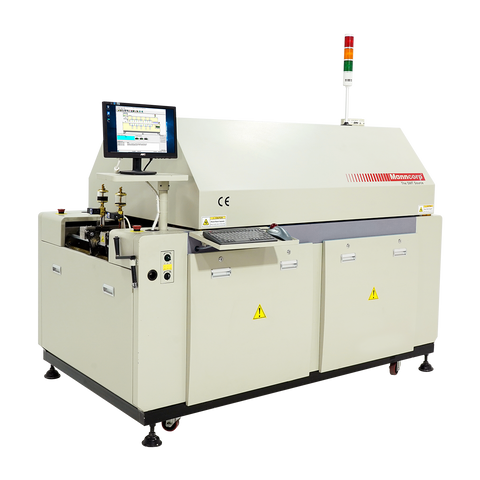
Batch or Compact Inline Reflow Oven
A first SMT line does not need to be oversized or overly complex. The key is selecting equipment that matches actual production needs, not peak theoretical speed.
Pick and Place Machine

The pick and place machine is the core of the SMT line, determining placement accuracy, component compatibility, and how efficiently the line can change from one product to the next. Because most first SMT lines operate in mixed or evolving production environments, the machine’s day-to-day usability often matters more than its peak specifications.
For first-time SMT lines, important considerations include:
- Real-world throughput, which reflects actual output after accounting for feeder setup, vision inspection, and changeovers—not just advertised components per hour
- Feeder capacity and availability, since insufficient feeders or slow feeder swaps can become a larger bottleneck than placement speed
- Package support, including QFN, BGA, fine-pitch ICs, connectors, and odd-shaped components commonly found in modern designs
- Software usability and support, which affects programming time, operator training, and recovery from errors
In practice, many manufacturers find that a placement machine with slightly lower rated speed but faster setup, clearer software workflows, and readily available feeders produces more usable boards per shift than a higher-speed platform optimized for continuous, high-volume runs.
Choosing the right pick and place machine is one of the most important decisions in a first SMT line, and it affects throughput, changeover time, and long-term scalability. For a deeper breakdown of what first-time buyers should evaluate, see Choosing Your First Pick and Place Machine.
Pick and Place Machines: Productive Speed vs Advertised Speed
Ultra-high-speed placement platforms from global OEMs are optimized for continuous, high-volume production with stable product mixes. For a first SMT line, those assumptions often don’t hold.
Productive speed depends on:
- Feeder loading and setup time
- Component diversity
- Vision inspection time per placement
- Operator experience
- Downtime between jobs
In many first-line environments, a machine running at a lower rated CPH can produce more usable boards per shift than a higher-speed platform with longer changeovers and steeper learning curves.
The right first pick and place machine is one that operators can keep running—not one that looks fastest on paper.
Solder Paste Printer

Solder paste printing is one of the most common sources of SMT defects, including insufficient solder, bridging, and poor wetting. Because every downstream process depends on print quality, inconsistencies at this stage often appear later as placement or reflow issues—even when those machines are performing correctly.
Solder paste printing options typically include:
- Manual stencil printers, which rely heavily on operator technique and are best suited for prototyping or very low volumes
- Semi-automatic printers, which control key variables such as squeegee speed, pressure, and alignment while retaining a small footprint
- Fully automatic inline printers, which offer closed-loop control and are designed for continuous, unattended production
For a first SMT line, semi-automatic printers are often the most practical choice. They deliver significantly better repeatability than manual printing, support fine-pitch components, and integrate cleanly into early production workflows—without the cost, floor space, or process complexity of a fully automatic inline system.
Just as importantly, semi-automatic printers allow new SMT teams to establish stable printing processes and inspection habits before advancing to higher levels of automation as volumes increase.
Reflow Oven

The reflow oven solders all SMT components by applying a controlled thermal profile that activates the solder paste, forms reliable joints, and protects temperature-sensitive components. Because every board must pass through reflow, the oven effectively sets the upper limit on line throughput.
Key reflow oven considerations include:
- Heated tunnel length, which determines how much thermal energy can be applied at a given conveyor speed
- Conveyor speed and throughput matching, ensuring the oven is balanced with upstream placement and printing processes
- Lead-free capability, which requires higher and more tightly controlled temperatures than tin-lead processes
- Thermal profiling flexibility, allowing profiles to be tuned for different board designs, component densities, and solder pastes
In first SMT lines, reflow ovens are often oversized in an effort to “future-proof” capacity. In practice, an oven that exceeds the throughput of the pick-and-place machine or printer does not increase output—it simply adds cost, floor space, and energy consumption.
Reflow ovens should be selected to match actual line throughput, with enough flexibility to handle expected board sizes and profiles. As production volumes grow, capacity is typically added upstream through placement speed or parallel lines rather than by replacing an already capable oven.
Reflow Ovens: Matching Throughput, Not Exceeding It
Reflow ovens are often overspecified in first SMT lines, adding cost and floor space without increasing output.
Production capacity through reflow is governed by:
- Heated tunnel length
- Required thermal profile duration
- Conveyor speed
- Board length and spacing
A reflow oven should be selected to match the upstream placement rate, not exceed it. Oversizing the oven does not improve throughput if placement or printing is the limiting factor.
Balanced lines outperform overbuilt ones.
A Practical Throughput Example
As one practical example, Manncorp’s
CR5000 reflow oven
has a 75-inch heated tunnel.
A typical lead-free reflow profile is approximately
5 minutes, resulting in a conveyor speed of about 15 inches per minute.
For a 15-inch PCB, this means the oven can support one board per minute, or roughly 60 boards per hour, assuming continuous flow.
If the upstream pick-and-place machine produces one board every 2–3 minutes, increasing oven length or speed will not increase total line output—the placement process remains the constraint.
For this reason, reflow ovens should be selected to match actual line throughput, not exceed it unnecessarily. Oversizing the oven increases cost and floor space without improving production until upstream bottlenecks are addressed.
4. Inspection and Quality Control
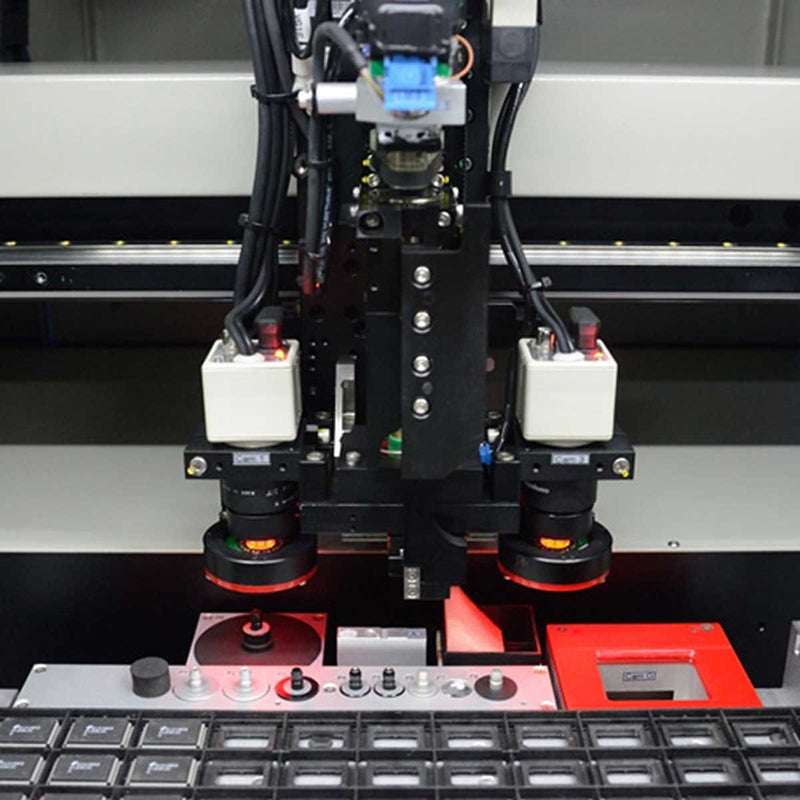
Inspection ensures solder joints meet quality requirements and that defects are identified before they reach downstream processes or customers. Because inspection effectiveness directly impacts yield and rework cost, it should be treated as a process decision, not just an equipment choice.
Depending on production volume, product complexity, and risk tolerance, inspection may include:
- Visual or microscope inspection, which can be effective for early lines when operators are trained and defect rates are low
- Placement machine vision data, used to verify component presence, polarity, and placement accuracy during assembly
- Automated optical inspection (AOI), which provides consistent, repeatable defect detection as volumes increase
- X-ray inspection, typically reserved for hidden solder joints such as BGAs or bottom-terminated components
Not every first SMT line requires AOI or X-ray on day one. Many manufacturers begin with structured visual inspection and leverage placement machine vision, then add AOI or X-ray only when volumes, component density, or quality requirements justify the investment.
The most effective inspection strategies are planned from the start and scaled deliberately, ensuring quality improves in step with production rather than becoming a late-stage bottleneck.
Board Handling and Support Equipment
Board handling and support equipment move PCBs between processes and provide mechanical stability during placement, reflow, and inspection. While these systems are standard in high-volume SMT lines, they are not always required in first-time or low- to mid-volume environments.
Common board handling and support equipment includes:
- Inline conveyors
- Board loaders and unloaders
- PCB support pins or tooling
- Work-in-process buffering
When Board Handling Equipment Makes Sense
Board handling equipment typically becomes valuable when:
- Production runs are long enough that manual loading becomes a bottleneck
- Multiple operators are involved across the line
- Boards are large, thin, or flexible and benefit from added support
- The line runs continuously for extended periods
- Reducing handling damage or operator fatigue is a priority
In these cases, conveyors and loaders improve consistency, reduce board damage, and help maintain steady line flow.
When Board Handling Equipment Is Often Unnecessary
In early SMT lines, board handling equipment can be safely deferred when:
- Volumes are low or highly variable
- Operators already manage loading and unloading without delays
- Floor space is limited
- The line is frequently reconfigured for different products
Manual board handling can remain effective during early adoption, especially when paired with clear workflows and disciplined operator practices.
A Practical Scaling Approach
Many manufacturers add board handling equipment incrementally, starting with manual loading and simple conveyors, then introducing loaders, unloaders, or buffering only after manual handling becomes a measurable constraint.
This staged approach keeps capital costs and floor space under control while ensuring that automation is added to remove real bottlenecks—not hypothetical ones.
5. How to Size Your First SMT Line Correctly
Oversizing is one of the most common—and expensive—mistakes first-time buyers make.
When sizing a line, consider:
- Annual and monthly production volumes
- Product mix and changeover frequency
- Component diversity
- NPI vs steady-state production
- Operator skill levels
Example layouts for small footprints:


Productive speed depends on more than CPH. Changeovers, feeder setup, inspection time, and reflow dwell all affect real output.
A well-sized first SMT line should meet today’s needs while allowing modular expansion as volumes grow.
Sizing Your First SMT Line: How Real Manufacturers Scale
The most successful first SMT lines are designed with deliberate constraints.
Rather than buying for a future state that may never materialize, manufacturers should:
- Size for current and near-term demand
- Preserve floor space and capital
- Choose platforms that allow incremental upgrades
- Add automation only when it removes a proven bottleneck
Many manufacturers add a second placement head, offline feeder setup, or inline inspection long before they need a higher-speed platform.
In high-mix or evolving production environments, product mix and changeover frequency often have a greater impact on output than raw placement speed. This is explored in more detail in How to Choose a Pick and Place Machine Based on Product Mix, Not Speed.
6. SMT Line Cost: What U.S. Manufacturers Should Expect
The cost of a first SMT line can vary significantly depending on automation level, throughput targets, product mix, and inspection requirements. For most U.S. manufacturers, the goal is not to minimize upfront spend, but to invest in a line that can be brought online quickly and operated reliably.
Typical cost considerations include:
- Equipment cost, whether purchasing new, used, or a mix of both
- Installation and training, including operator and process training needed to reach stable production
- Tooling and feeders, which are often underestimated and can materially affect changeover efficiency
- Facility preparation, such as electrical power, compressed air, ESD controls, and floor layout
- Ongoing support and service, which influence uptime and long-term operating cost
While entry-level SMT lines may require less capital upfront, long-term ROI is usually driven by factors that are harder to see on a quote: uptime, ease of use, access to support, and how easily the line can be expanded as production grows.
Many manufacturers find that a moderately higher initial investment in the right-sized equipment and support model results in faster ramp-up, fewer production disruptions, and lower total cost of ownership over the life of the line.
7. Facility and Compliance Considerations in the U.S.
Facility readiness is one of the most common sources of delay when installing a first SMT line. Even well-specified equipment can sit idle if power, air, or safety requirements are not addressed in advance. Planning these details early helps ensure installation and ramp-up proceed smoothly.
Before installation, U.S. manufacturers should plan for:
- Electrical and compressed air requirements, including adequate voltage, amperage, and air quality for placement machines, printers, and reflow ovens
- ESD control and grounding, such as ESD flooring, wrist straps, grounding points, and material handling practices to protect sensitive components
- Lead-free compliance, which may affect reflow temperatures, ventilation, and material handling procedures
- OSHA and safety considerations, including guarding, emergency stops, signage, and safe operator access around moving equipment
- Floor space and line layout, allowing room not only for the machines themselves but also for operators, material staging, maintenance access, and future expansion
Many first-time SMT installations underestimate how much space and infrastructure is required beyond the machines alone. Addressing these requirements during line design—rather than after equipment arrives—reduces last-minute modifications, installation delays, and unexpected costs.
Planning for facility and compliance needs early prevents costly delays during installation.
8. Turnkey SMT Lines vs Piecing It Together
Some manufacturers purchase equipment individually from multiple vendors. Others choose a turnkey SMT line designed, installed, and supported by a single supplier.
The turnkey approach typically includes:
- Integrated line design, ensuring printers, placement machines, reflow ovens, and handling equipment are properly balanced
- Reduced compatibility risk, avoiding software, mechanical, or process mismatches between machines
- Faster commissioning, since the line is designed and tested as a system rather than assembled in the field
- A single point of accountability, simplifying troubleshooting, support, and service coordination
For experienced SMT teams with in-house process engineers, sourcing equipment individually can make sense. For first SMT lines, however—especially in organizations without prior SMT expertise—the risks are higher. Integration issues, unclear ownership of problems, and extended ramp-up periods can delay production and erode confidence in the line.
Turnkey SMT lines help first-time buyers reach stable production sooner by transferring integration responsibility to a supplier with line-level experience. This reduces risk, shortens time to first board, and allows internal teams to focus on building product rather than debugging equipment interactions.
For first SMT lines—especially for teams without prior SMT expertise—turnkey solutions often reduce risk and time to production.
Turnkey SMT Lines: Reducing Risk, Not Control
Global OEMs often assume in-house engineering teams with deep SMT experience. First-line buyers rarely have that luxury.
A turnkey SMT line approach reduces risk by:
- Ensuring line-level balance from day one
- Eliminating compatibility gaps between machines
- Shortening time from delivery to production
- Providing a single point of accountability
For first SMT lines, integration experience often matters more than brand pedigree.
9. When Ultra-High-Speed SMT Platforms Make Sense
Ultra-high-speed SMT platforms are built for stable, high-volume production. They perform best when product mixes are consistent, changeovers are rare, and lines run continuously with dedicated process engineering support.
These platforms are most effective when:
- Volumes are high and predictable
- Changeovers are infrequent
- Lines run multiple shifts
- Dedicated SMT engineers manage optimization
- Capital investment is justified by marginal efficiency gains
For a first SMT line, those conditions are often not yet in place.
Many manufacturers bringing SMT in-house for the first time are balancing prototyping, production, and frequent design changes with lean teams. In these environments, usable production time matters more than peak placement speed.
Simple Production Reality Formula
Usable Output per Shift = Placement Rate × (Scheduled Time − Changeover Time)
Or stated another way:
Boards per Shift ≈ Total Placements ÷ (Available Runtime after Changeovers)
This is why first SMT lines often benefit from platforms optimized for uptime, usability, and fast changeovers, not maximum CPH.
In practice, many manufacturers follow a sequenced adoption path:
- Start with a right-sized, flexible production line that operators can keep running
- Add ultra-high-speed platforms later, once volumes, staffing, and product stability justify the investment
This approach preserves capital, reduces risk, and aligns SMT capability with real production needs.
In a first SMT line, actual throughput is determined by usable runtime after changeovers, not by a machine’s advertised components-per-hour rating.
10. From Purchase Order to First Board: What the Timeline Looks Like
A typical first SMT line project follows a predictable sequence:
- Line specification and quoting, based on production goals and product requirements
- Equipment delivery, coordinated to match site readiness
- Installation and setup, including mechanical, electrical, and software configuration
- Operator training, covering both operation and basic troubleshooting
- First production boards, produced on the customer’s own line
Most delays in first SMT line projects occur not because of equipment issues, but due to underestimated facility preparation, incomplete process planning, or insufficient training.
To avoid these delays, Manncorp takes an active role in guiding customers through each stage of the process. This includes validating facility requirements early, sequencing equipment delivery to match site readiness, and ensuring operators are trained on and running their own boards before technicians leave. By addressing these common bottlenecks upfront, manufacturers are more likely to move from delivery to stable production without extended downtime.
11. Common Mistakes First-Time SMT Buyers Make
- Paying for speed that changeovers prevent them from using
- Selecting platforms optimized for mass production, not mixed production
- Underestimating feeder strategy and setup time
- Delaying inspection planning until defects appear
- Choosing vendors with strong specs but limited support access
These mistakes are rarely visible in brochures—but they dominate real production outcomes.
12. Is an SMT Line Right for You? A Quick Checklist
An SMT line is often a good fit if:
- Volumes are predictable or growing
- Design iterations are frequent
- IP control matters
- Quality and responsiveness are priorities
If volumes are extremely low or inconsistent, outsourcing may still make sense.
13. Why U.S. Manufacturers Choose Manncorp for Their SMT Lines
U.S. manufacturers choose Manncorp not because they are looking for entry-level solutions, but because they want production equipment that is sized correctly for their current reality and scalable for what comes next.
Manncorp supports manufacturers across multiple stages of growth, from their first in-house SMT line through subsequent expansions. This includes:
- Designing SMT lines that produce reliably from day one and remain productive as volumes increase
- Supporting teams with or without dedicated SMT engineers, through both early adoption and later scaling
- Balancing throughput, flexibility, and cost at the line level—not just at the machine level
- Providing U.S.-based support that continues as lines expand, shift mixes change, and new products are introduced
Many manufacturers start with Manncorp for their first production line and continue to scale with additional lines, higher throughput configurations, or expanded inspection and automation—without needing to replace their existing investment prematurely.
To help manufacturers get to the right configuration faster, Manncorp introduced the first online SMT line builder. This tool recommends SMT equipment based on a manufacturer’s actual production specifications—such as board size, component mix, and throughput goals—making it possible to visualize an ideal SMT line in minutes instead of spending hours researching or waiting for quotes.
By removing guesswork early in the process, manufacturers can quickly see what a properly sized line looks like, understand tradeoffs, and start planning with confidence. Many then move from that initial configuration into a fully supported production line that can be expanded with additional placement capacity, inspection, or automation as demand grows.
This approach allows manufacturers to scale SMT capability deliberately, adding capacity and complexity when it delivers real value—rather than committing to oversized platforms before production and staffing justify them.
14. Next Steps
If you’re considering your first SMT line:
Use our easy online tool to Build Your Own SMT Line tailored to your production needs.
-
Send us a BOM for a Free Analysis and get a customized SMT equipment quote in hours—not weeks—based on your actual boards, volumes, and production goals.
Or reach out to start a conversation about your production:


Related Reading
- Choosing Your First Pick and Place Machine
- How to Choose a Pick and Place Machine Based on Product Mix, Not Speed
- Best Entry-Level Pick and Place Machines for OEMs
15. Frequently Asked Questions About Your First SMT Line
What equipment is required for a basic SMT line?
A basic SMT line typically includes a solder paste printer, a pick and place machine, a reflow oven, and an inspection method. Board handling and automation can be added as production volume and consistency requirements increase.
How much does a first SMT line cost in the U.S.?
The cost of a first SMT line varies widely based on automation level, throughput, inspection requirements, and support needs. Most manufacturers focus on total cost of ownership, including installation, training, tooling, and long-term support, rather than equipment price alone.
Is it better to buy a turnkey SMT line or individual machines?
For first-time SMT lines, turnkey SMT solutions often reduce risk by providing integrated line design, faster commissioning, and a single point of accountability. Manufacturers with experienced SMT teams may choose to source equipment individually, but integration risk is higher.
How do I size my first SMT line correctly?
First SMT lines should be sized based on real production needs, including product mix, changeover frequency, and operator experience. Usable runtime and line balance typically matter more than peak components-per-hour ratings.
Do I need AOI or X-ray inspection for my first SMT line?
Not every first SMT line requires AOI or X-ray inspection at launch. Many manufacturers begin with visual inspection and placement machine vision, then add AOI or X-ray as volumes, component density, or quality requirements increase.
How long does it take to go from purchase order to first board?
A typical first SMT line project includes specification, delivery, installation, training, and first production runs. Delays most often come from facility readiness, training gaps, or inspection planning, which can be reduced through early planning and guided implementation.
Can SMT lines be scaled over time?
Yes. Many manufacturers scale SMT production by adding capacity, automation, inspection, or additional lines in stages. A well-designed first SMT line should support second and third lines without requiring full replacement of existing equipment.
Is bringing SMT in-house always the right choice?
In-house SMT assembly is often beneficial when volumes are predictable, IP control is important, and rapid iteration is needed. Outsourcing may still make sense for extremely low, inconsistent, or end-of-life production.
What are the most common mistakes first-time SMT buyers make?
Common mistakes include oversizing equipment, underestimating feeder and tooling needs, delaying inspection planning, and prioritizing peak speed over real-world usability and support.
How does Manncorp support first and future SMT lines?
Manncorp designs, installs, and supports SMT lines for manufacturers at every stage—from first in-house line through later expansion—helping teams avoid delays, scale deliberately, and maintain reliable production as volumes grow.


